

The homunculus is one of the coolest brain areas you may not know exists. It has significant implications for movement and exercise. It’s also a critically important part of the brain when it comes to chronic pain recovery.
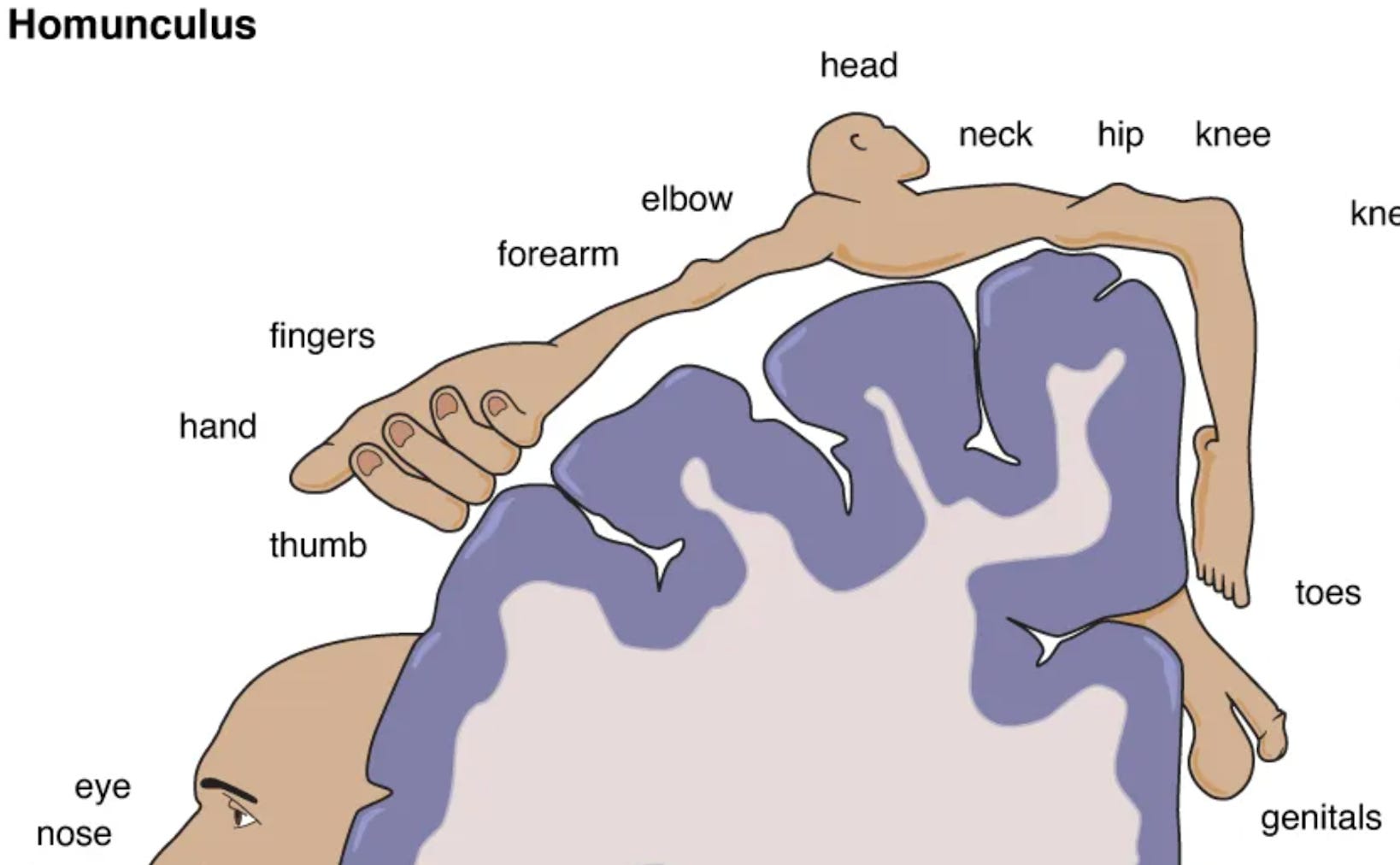
Your homunculus is a human-like representation of your body that resides, naked and in full repose, in your brain. Laid across your brain’s cortex, deconstructed and yet thoughtfully organized, allowing mind and body to stay connected in the interest of movement.
Encylopedia Brittanica
Basically, this homuncular part of the brain represents how your brain sees your body. I describe it functioning like a call-and-response center. Information travels up the spinal cord from the tissues (call), where it’s quickly interpreted by the brain, leading to an output (response) creating an action in the body.
Britannica
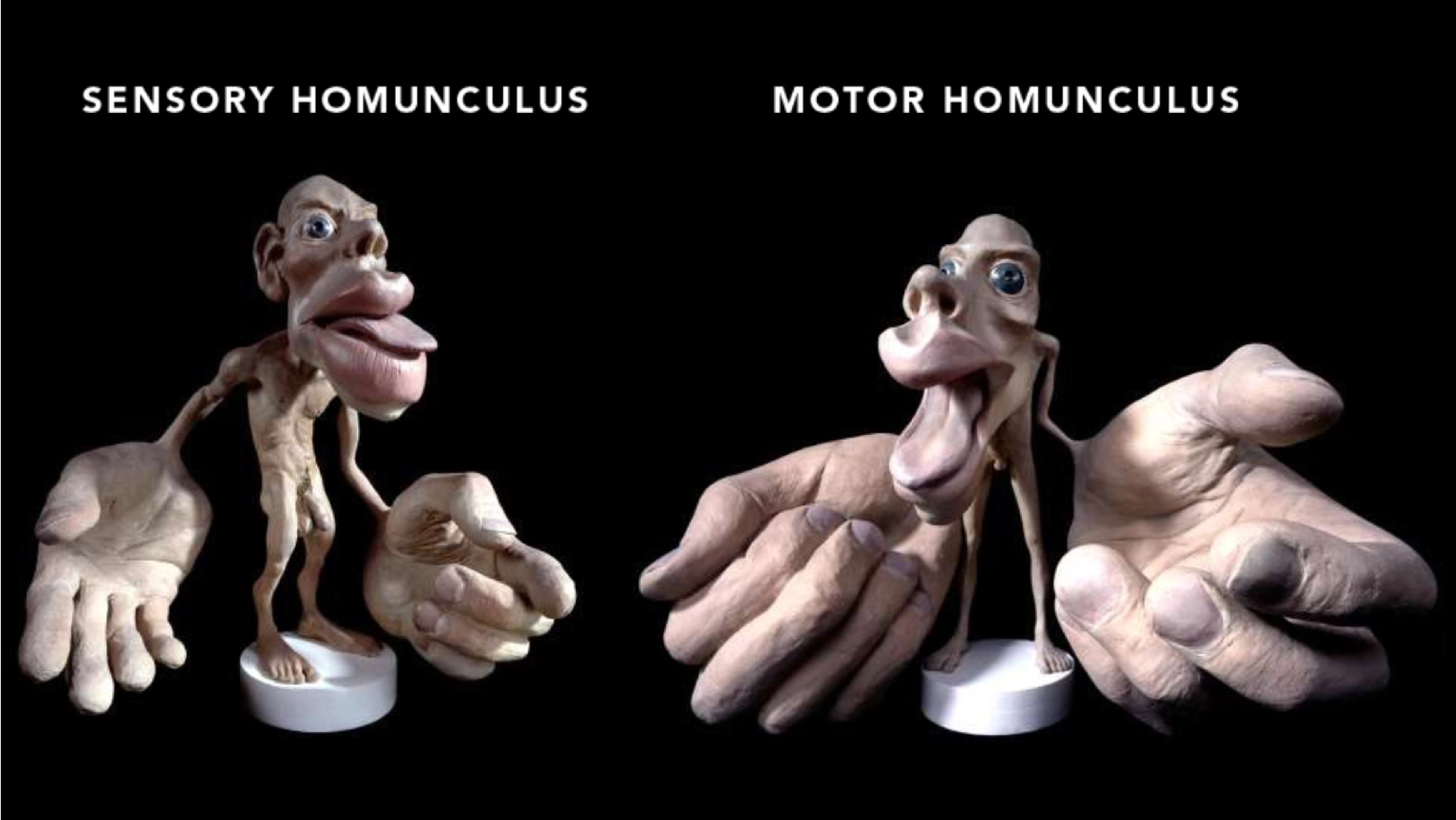
Above is an artist's rendering of how the brain sees the body based on how much brain space is dedicated to each part. Notice how the eyes, tongue, ears, hands, feet, and other parts that need more fine motor control, or which are more sensitive, are larger. and take up more brain space. While body parts that need less sensory attention, like the arms, legs, and torso, are relatively smaller. The other image shows how the body is laid out across the cortex in pieces that are not necessarily connected. Notice how the toes are near the genitals, which is one reason foot fetishes make complete sense.
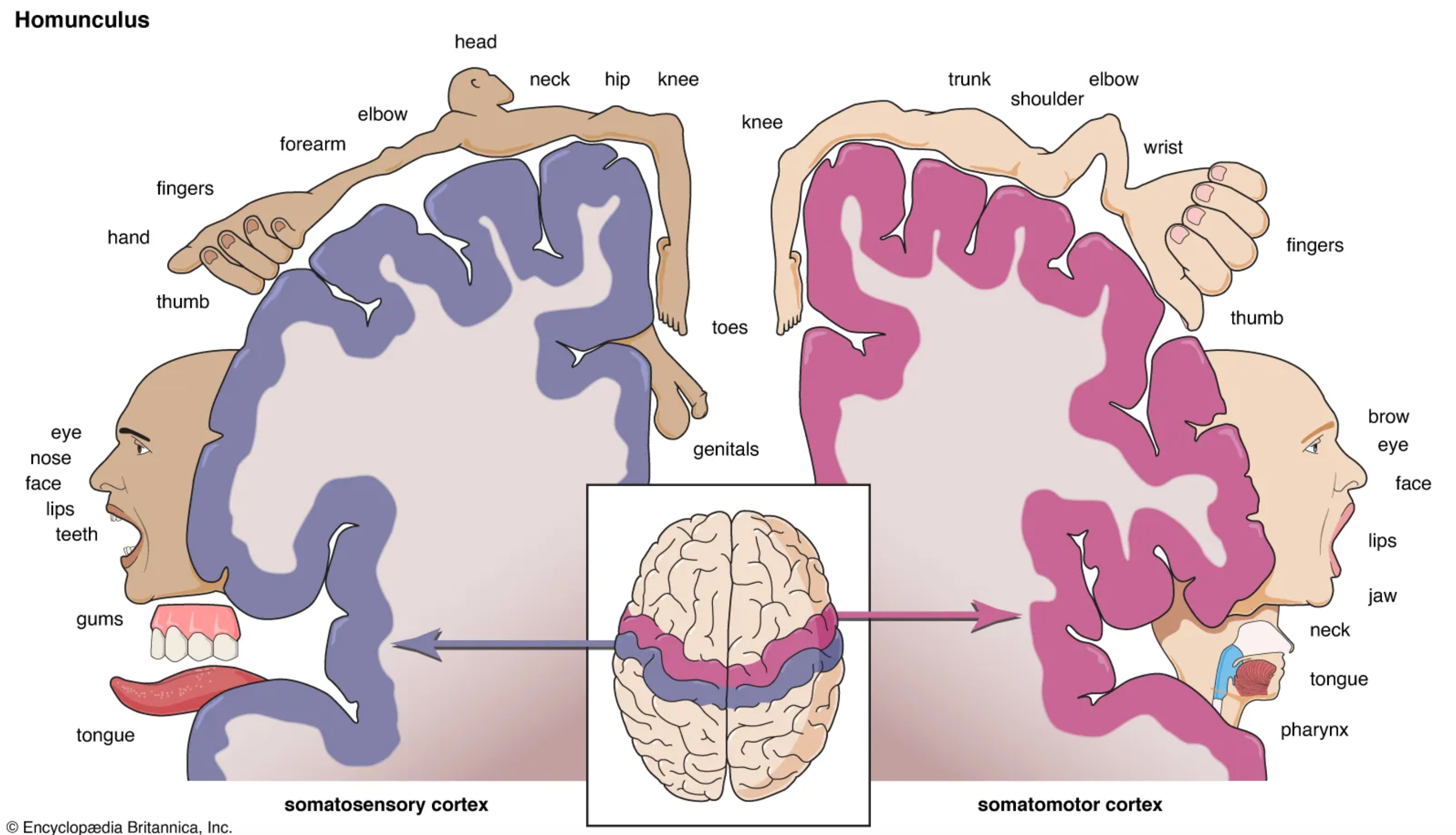
The pink (sensory) homunculus receives raw information from the body and connects it to deeper brain areas for processing. Once those deeper brain areas make sense of the information based on its programming, informed by past experience and future prediction, the purple (motor) homunculus sends signals back to the body to direct movement. That’s an incredible amount of data crunching in a short period of time. But this allows you to adapt your movement to your environment, a bit like a chameleon, based on myriad mind-and-body predictions. For instance, if you step on something sharp, your body might quickly adapt to avoid the object or unweight the foot to prevent further damage.
Some Key Actions and Functions Of The Homonculus
Voluntary Movement Initiation: It sends signals for precise, intentional movements of muscles.
High-Precision Control: The hands, fingers, lips, and tongue occupy large areas of the brain, reflecting their capacity for complex, fine-motor tasks.
Fine Motor Coordination: It manages detailed movements of areas that require it to coordinate larger muscle groups that stabilize and support these fine and highly accurate movements.
Action Integration (Recent Research): Updated models suggest areas of the motor cortex also link to cognitive planning, goal-driven actions, and coordination between multiple body parts, rather than just isolated muscle control.
The homunculus matters because it relies on frequent, diverse, strong, and accurate information from the environment to stay clear about how best to navigate the world. So you can stay clear on where you end and where the world begins. What’s fascinating about this brain area is that it’s always changing depending on what you’re up to. Move, exercise, and interact with the world, and clarity improves. Sit still to watch a movie or read, and activity degrades. Recent studies show that after only a few minutes of inactivity, the homunculus starts to lose clarity, becoming “smudged”. Blurry and out of focus.

Sitting at your desk, driving in the car, watching TV, eating a meal, and even sleeping start to change your brain’s relationship with your body. I call this phenomenon “sleep mode,” where a period of inactivity temporarily deactivates parts of the homunculus that aren’t needed. This is normal and healthy and is a way for the brain to save energy and prioritize other functions. Smudging is why we feel stiff and even hurt when we first get up from a chair, out of the car, or out of bed in the morning. It’s not because you’re getting old. My 18-year-old son and I both struggle to get moving after a 3-hour drive to the ski hill. The brain is like, “Whoa, whoa, slow it down, cowboy. Give me a second to reconnect”. One reason a short warm-up can improve the quality of your workout is that repetition and practice improve the quality of your movement.
So if this transitory clarity of the homunculus is normal, what’s the problem with chronic pain?
Wait there’s more! Please become a paid subscriber to read on…
