

Thinking differently about movement has many physical and psychological benefits. If you’re recovering from pain, injury, or surgery, you have a natural opportunity to evaluate your movement practice. But if you feel stale, bored, plateaued, or uninspired with your exercise routine, or you’ve just been on autopilot and are curious about where to go next, this article is for you. If you want to dive (much) deeper, my next 12-week virtual cohort of “Unlearning Pain For Athletes” starts March 15th. There are only a few spots left and you can learn more HERE. In the meantime, I’m trying out a new format for this week’s post. Please let me know what you think.
There are no “bad” movements, only movements your nervous system doesn’t recognize or has learned are dangerous.
Human beings are the undisputed best movers on the planet. By “best” I mean we have the largest and most diverse range of movement capabilities of any species on earth. We are also the most adaptable, partly due to our capacity for higher-level thinking combined with the amazing way in which our bodies physically change and become robust to better tolerate the things we choose to do. Here are 3 short clips I saw this week on Instagram that reinforce this idea. Your body will adapt to anything you ask it to do with practice and repetition.
Our challenge is that because we’re exposed to such a wide variety of physical demands, some of them unexpected, pain often results when the nervous system gets surprised. So while I’m not going to say that anything goes when it comes to movement, your capacity to do things is generally governed by your nervous system and not your tissues. If you want to learn to tolerate getting punched in the face better, you can adapt to that. If you want to learn to run 100 miles, you can adapt to that. If you want to learn to practice high-level Ashtanga yoga and twist yourself into a pretzel, you will adapt to that too. Training your body to tolerate things better requires doing more of that thing, not less.
What many people don’t know is that once your brain and nervous system learn, somewhere along the way, that a particular movement is dangerous, it will remember that and code it as such. Think deadlifting, running, squatting, falling, etc. Skiing many years ago, I fell off a rail on my first try when I committed to trying to jump on and slide sideways. Both my skis slipped out and I fell 3 feet to the ground with my arm overhead landing on my side. I had instant arm pain and tingling in my fingers the rest of the day along with a sore shoulder for a few weeks. From then on, every time I tried to ski toward a rail to try it, my brain wouldn’t let me commit. I could literally FEEL the incident and would pull off and avoid it at the last minute. That is until my son helped me break down the skill and gradually learn to do it safely. I’m still working through my trepidation, but I would have never learned that skill without trying it again.
“Take your pain and go play with it” -Charlie Chaplin
Movement is supposed to be fun, right?
Somewhere along the way, many of us (myself included) learn that the primary goal of movement is to punish ourselves and suffer to achieve some goal. Lose weight, beat others, suffer better, look a certain way, feel less anxious, burn calories, prove our worth, add muscle, impress others, etc. Now, if your goal is to achieve some performance standard because you’re an athlete for a living, or because you honestly and authentically enjoy doing hard things, then punish yourself and suffer away. The reality is that to achieve a specific big burly goal that’s exceptional and requires significant fitness and skill acquisition, most of your “training” will be aimed at consistently working quite hard. While the feeling of punishment and suffering is probably more the result of one’s mindset, few things worth doing are easy.
As I’ve gotten older, I’ve purposefully separated exercise (which is goal-directed and structured) from movement (which is more free-form, playful, and enjoyable). There are times when I truly enjoy pushing myself hard toward some goal. But there are other times when I really just love moving and being in my body for the sheer pleasure of feeling the world around me. I literally decide what I want to do on a given day based on how I feel and what’s turning me on. I realize this improv schedule doesn’t work for everyone, but what I want you to consider when curating your movement practice is your “why”. Stay in touch with WHY you’re choosing to exercise and move in certain ways and make sure those motives align with your values. If they don’t, change it up, and while you’re at it, ensure that a good chunk of your movement is fun and joyful. My experience is that play, fun, novelty, and emergent exploration are active ingredients in terms of performance, resilience, and longevity.
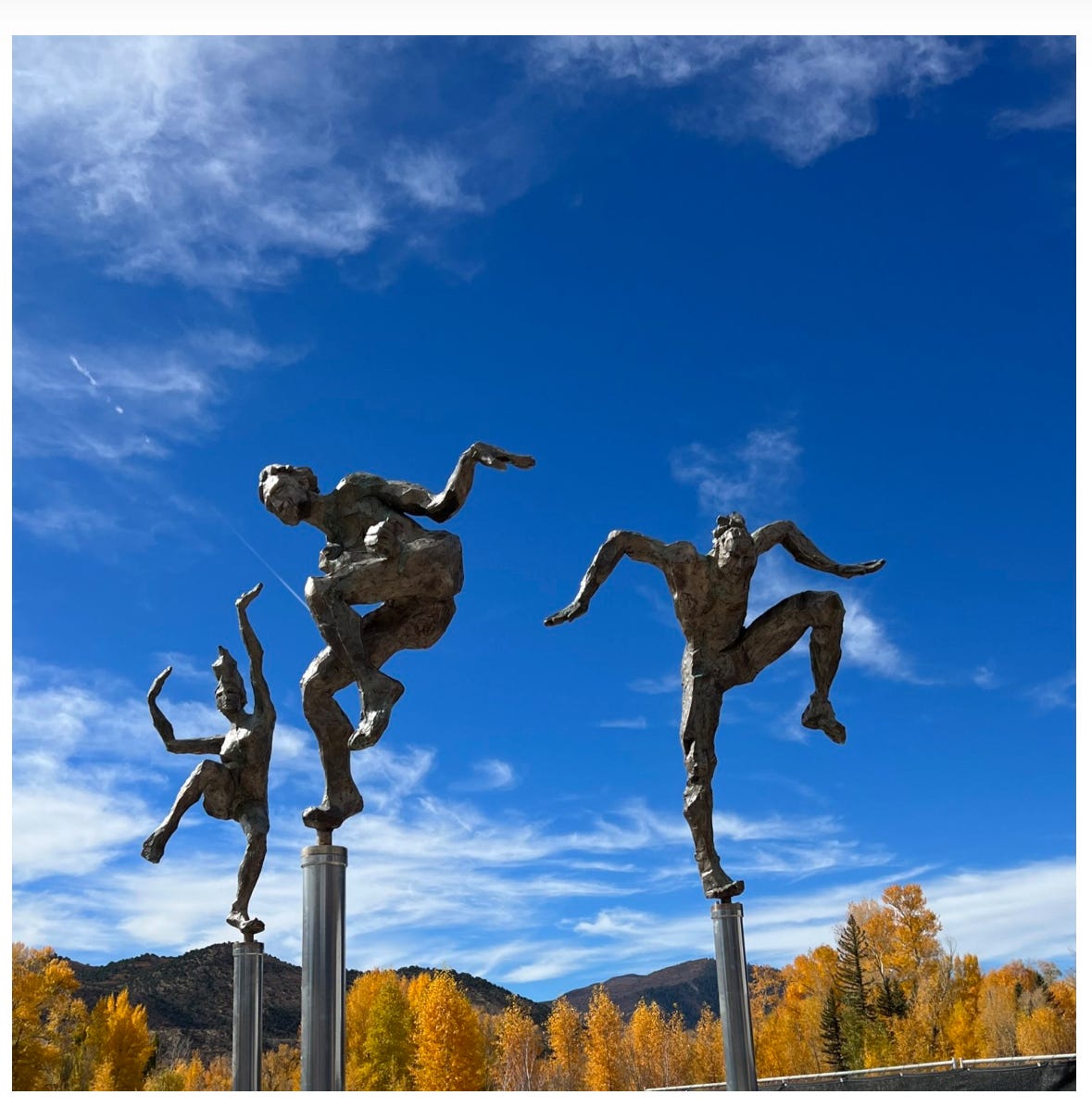
Image/Artist: Gail Folwell
“Consciousness is only possible through change; change is only possible through movement” - Aldous Huxley
Are you exploring or exploiting?
These terms have changed my movement practice for the better since I learned about them a few years ago. Exploitative movement is familiar, it’s expected, you’ve done it before and mostly know the outcome. It’s satisfying and gives you a reliable hit of dopamine and oxytocin every time. You count on it because it’s reliable and joyful in its predictability. Think about your familiar running route, your weekend match of tennis on the same courts with familiar partners, or your 10th day of skiing at your favorite mountain. Exploratory movement is nearly the opposite. It’s novel, unpredictable, unexpected, uncertain, and sometimes even fear/anxiety-inducing. You’ve not had an experience quite like it before and so it’s accompanied by a lovely sense of wonder and awe. Exploratory movement can feel thrilling during and afterward as you get a definite dopamine and oxytocin spike. But the nature and quality of that spike is palpably different.
Think about a run in a new city/country, playing tennis on clay with strangers while on holiday in Hawaii, or skiing in Japan with a guide in the backcountry. Same activities, different context, but yet exploratory in nature. Now picture activities and movements you’ve never done. Learning to surf, skydiving for the first time, dancing til sunrise at a nightclub in Europe, or taking your first CrossFit class. Brand new experiences that light up completely different neural networks in your brain. These are the ultimate type of exploratory movement.
Many of us steer toward exploitative movements as we get older. This results in the nervous system becoming less flexible, less resilient, more injury/pain prone, and specialized at fewer things. There’s room for this and it might even ultimately make up a majority of your movement practice. But I want to challenge you to start brainstorming how you might build more exploratory movements and activities into your life. We know that wonder, awe, novelty, play, nature, social connection, and healthy fear create wellness and health span. Are you open to working to find a balance between the two kinds of movement in your life? If so, please let me know if you notice how adding more exploratory movement enhances your experience with your favorite forms of exploitative movement. Variety is indeed the spice of life.
When there is no novelty, there can be no curiosity” -Aphra Behn
Make moves and be well my friends.