

Are You Intimidated by the A Word?
If you used to run, lift, hike, ski, or play field sports — and pain or other symptoms quietly took that away — you probably didn’t just flinch when you read the word “athlete” in the subject line. You might have sighed, assuming I’m not talking to you. Or felt a little pang of grief. That word used to apply to you, but right now it might feel like it only applies to someone else.
I’m here to tell you that you still own that word. It still applies to you. You may just have to unlearn a few things to rediscover your true nature.
Ido Portal said that movement complexity is one of the reasons we became human — that our brain development, and our climb to the top of the food chain, is tied directly to our capacity for complex movement. What he’s really saying is: every human being is built to be an athlete. Not “the best athlete on the planet.” Not a specific pace, PR, or body type. Just someone with the capacity to move and interact with the world in ways that are meaningful to you. To engage with the world on your own terms — regardless of how you feel right now, how much pain has held you back, or how long it’s been.
Nothing about that gap predicts your capacity to live the active, joyful life you’re actually built for. This, I believe, is your birthright.
Why This Word Makes People Squirm
I’ve noticed a pattern since I built the course Unlearning Pain For Athletes a few years ago: people consistently resist the word “athlete.” It makes them self-critical. They wave it off — “I’m not an athlete” & “that’s not me anymore” — especially if pain or other symptoms have left you feeling like there’s a “governor” on your ability to move. This reaction is critically important information.
Here’s my theory: that flinch is actually important data. If the word stings, it’s because some part of you misses what it used to mean. And that’s not a reason to talk yourself out of it. It’s the spark, the energy, to do the work of recovering this part of yourself. Your inner athlete.
What Your Nervous System Is Actually Doing
When pain shows up, fear and avoidance are natural responses — your nervous system, your mind and body, are doing their job. Trying to protect you. When there’s an actual injury, pain is meant to be a short-term danger signal that eases once you’ve addressed the issue. I’ve had injuries where pain turns off in hours, days, or weeks. Pain that sticks around much longer is a sign that the danger alarm has gone rogue.
A legit miracle: the human body heals reliably and efficiently. In fact, pain generally turns off long before healing is done. And most athletes don’t know that movement during healing actually improves recovery. But here’s the part almost nobody tells you: pain is often an early danger alarm, designed to go off before any damage happens, not because it already has. In an instant, your brain will light up a pain signal based on perceived threat alone — no damage or injury required. This pain is DEFINITELY not meant to stick around for too long. But it does because it has nothing to do with injury, and everything to do with far more interesting variables. The problem is, athletes rarely look at things like fear or life stress.
Think about the last time pain caught you off guard — mid-run, mid-lift, after your workout, days later, out of nowhere — and your brain immediately started drafting worst-case press releases. It’s my knee. I overdid it. I’m getting old. I’ll need surgery. I’ll never run again. I’ll lose my whole community, and no one will ever want to play with me again. Sound familiar? That spiral isn’t a character flaw — it’s your alarm system doing exactly what alarm systems do. The problem is that for many athletes, regardless of whether there was an injury, the alarm never learns to stand down. Fear reinforces it, and it keeps firing in situations that aren’t actually dangerous — sometimes for months or years after the tissue has completely healed.
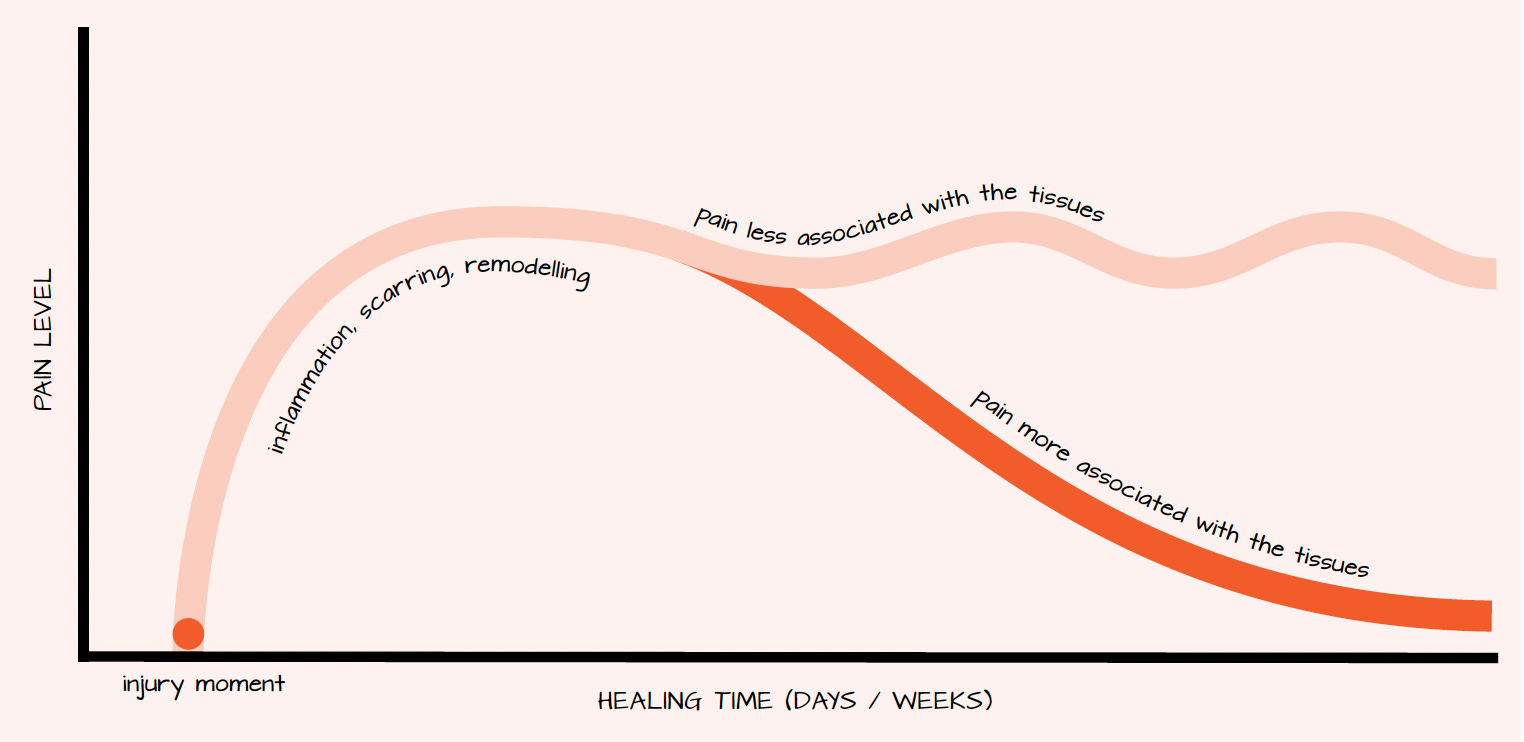
Moseley & Butler - “Explain Pain”
Pain that happens without injury, and pain that sticks around after healing, is just as “real” as pain due to bodily damage. Pain neuroscience over the last 20 years shows that the brain constructs pain, and is where all pain is experienced, regardless of the cause. But most pain in athletes that continues beyond 3 months comes from an alarm system that’s gotten stuck in the “on” position. This is one of the single biggest, most under-discussed reasons pain outlasts injury. Fear and avoidance end up holding people back more than almost any other force in life — from sport, from work, from relationships, from the stuff that actually makes life worth living. And this distracts from the other, more existential factors that most athletes miss. Stress connected to family, work, relationships, meaning, purpose, etc. Pain is an invitation to grow, and most athletes completely miss the message.
That gap — between what’s actually happening in your body and what your nervous system is convinced is happening — is exactly why I built this course. It’s a science-backed way to unlearn fear and avoidance, in sport and in life. A way to reconceptualize pain and other symptoms from “my body is dangerous” to “this is something I can understand, unlearn, and move through.” And maybe make sacred meaning and important life change in the process.
The Trap That Catches So Many Athletes
Here’s what gets me the most: someone who was active gets sidelined by pain or injury. They do the rehab, they heal — and the pain sticks around anyway, because their nervous system learned it along the way. But it almost never gets treated that way. Instead, they and their providers keep hunting for what’s still broken, stiff, weak, biomechanically faulty, which just breeds more fear and frustration. Especially when it fails to change symptoms.
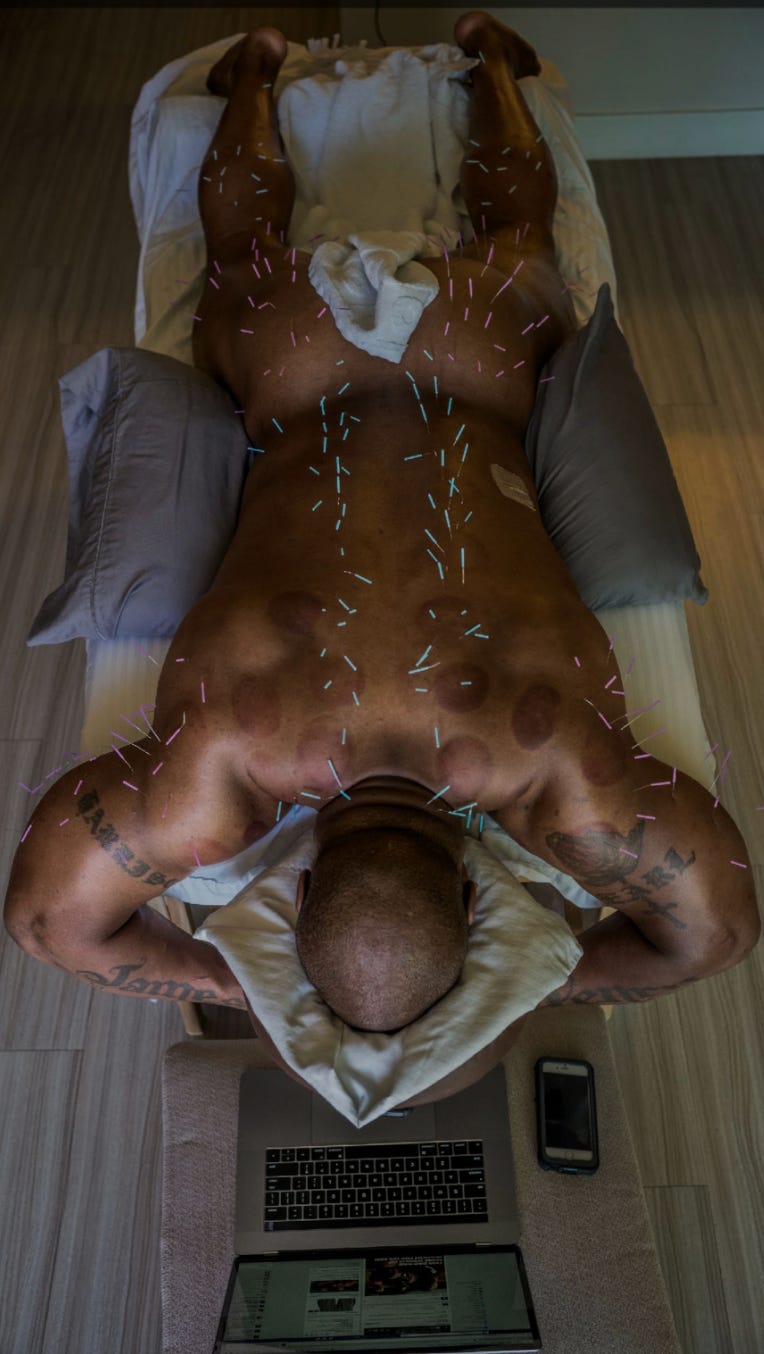
Pro Football Player, James Harrison
So athletes naturally pull back further, assuming they need more rest. Their world shrinks. They lose touch with their people, and sometimes with a piece of their identity — which, cruelly, stokes fear, reinforcing the very symptoms they’re trying to escape. It’s one of the most common — and most fixable — traps I’ve seen in nearly thirty years of clinical practice.
Add to that the lie our culture tells about aging bodies — that age automatically means wear and tear, lost capacity, and creeping irrelevance — and you’ve got a perfect recipe for fear and disconnection from your own potential. In sport, career, family, relationships- all of it.
There’s also a strong bias in both the athletic and medical worlds that pain means you overdid it, wore your body out like a machine that’s finally throwing a check-engine light.
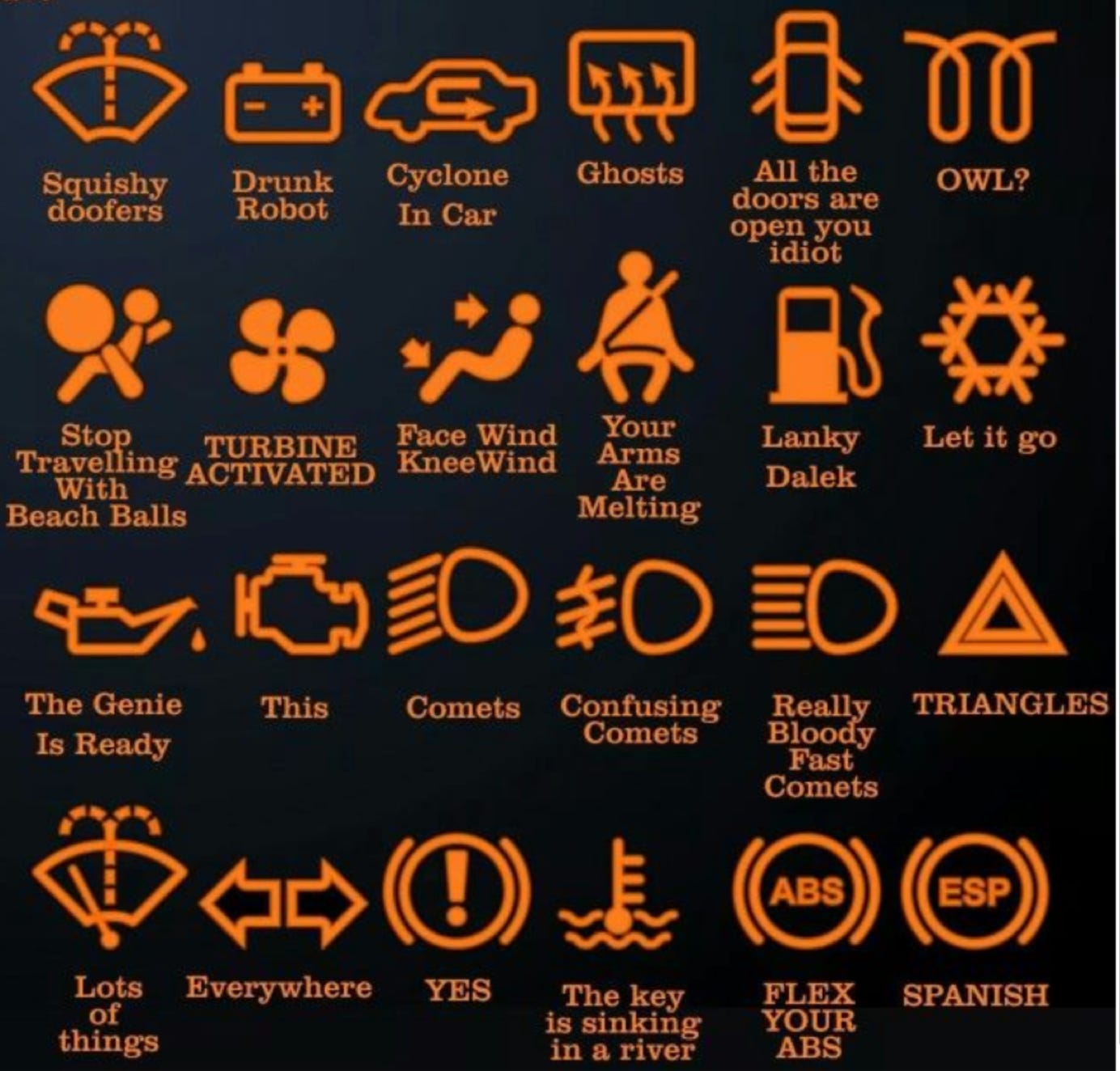
Because of that bias, active people and former athletes are often the last to hear about modern pain neuroscience — yet these are the most evidence-based and effective strategies to get them back. The idea that pain is primarily a problem of bodily damage might be the biggest lie in sports medicine.
You Don’t Have to Feel Like an Athlete Right Now to Be One
To be clear: this course was built for people who want to be active, but it was never built only for people who train for a living or who feel strong and capable today. If you haven’t moved freely in years, if pain has quietly rewritten what you believe you’re allowed to do with your body, this course is for you. Over 50 years of training, competing, and moving in myriad ways, I’ve learned that being an athlete was never just about performance. It’s about our relationship to movement — and that relationship, that energy, can absolutely be rekindled, no matter how long it’s been dormant.
Whatever “active” looks like for you — playing on the floor with your kids without fearing the consequences, walking the dog without dread, getting back on your bike with confidence, discovering something novel like dance, or just feeling like yourself in your own body again — that’s the goal. Not someone else’s definition of what it means to be an athlete. Your ability isn’t gone. It’s not damaged. It’s just temporarily on hold, and you can reconnect with it.
What’s Inside
The course follows an 8-week arc built to help you make sense of your story as a way to reclaim agency over your mind, your body, and your life:
Week 1 — Define the paradigm shift and understand modern pain science
Week 2 — Bust medical, fear-based provider, and athlete myths and remove the lies that fuel fear
Week 3 — Get clear on what’s true — and what isn’t — about your body, based on evidence
Week 4 — Get the green light to start moving again, with strategies that actually make it feel safe
Week 5 — Change your relationship with symptoms using somatic strategies
Week 6 — Connect sensation and emotion so your story finally makes sense
Week 7 — Build version 2.0 of you as a mover — and in life — based on your own goals
Week 8 — Put it all together into your personal pain-recovery recipe
The course is self-paced and fully asynchronous, and you’ll have access forever. I’ve also added a live community so we can do this work together — I’ll be live on a Zoom meeting with you and a group of like-minded people every other Tuesday at 12pm MT, with more time options coming soon.
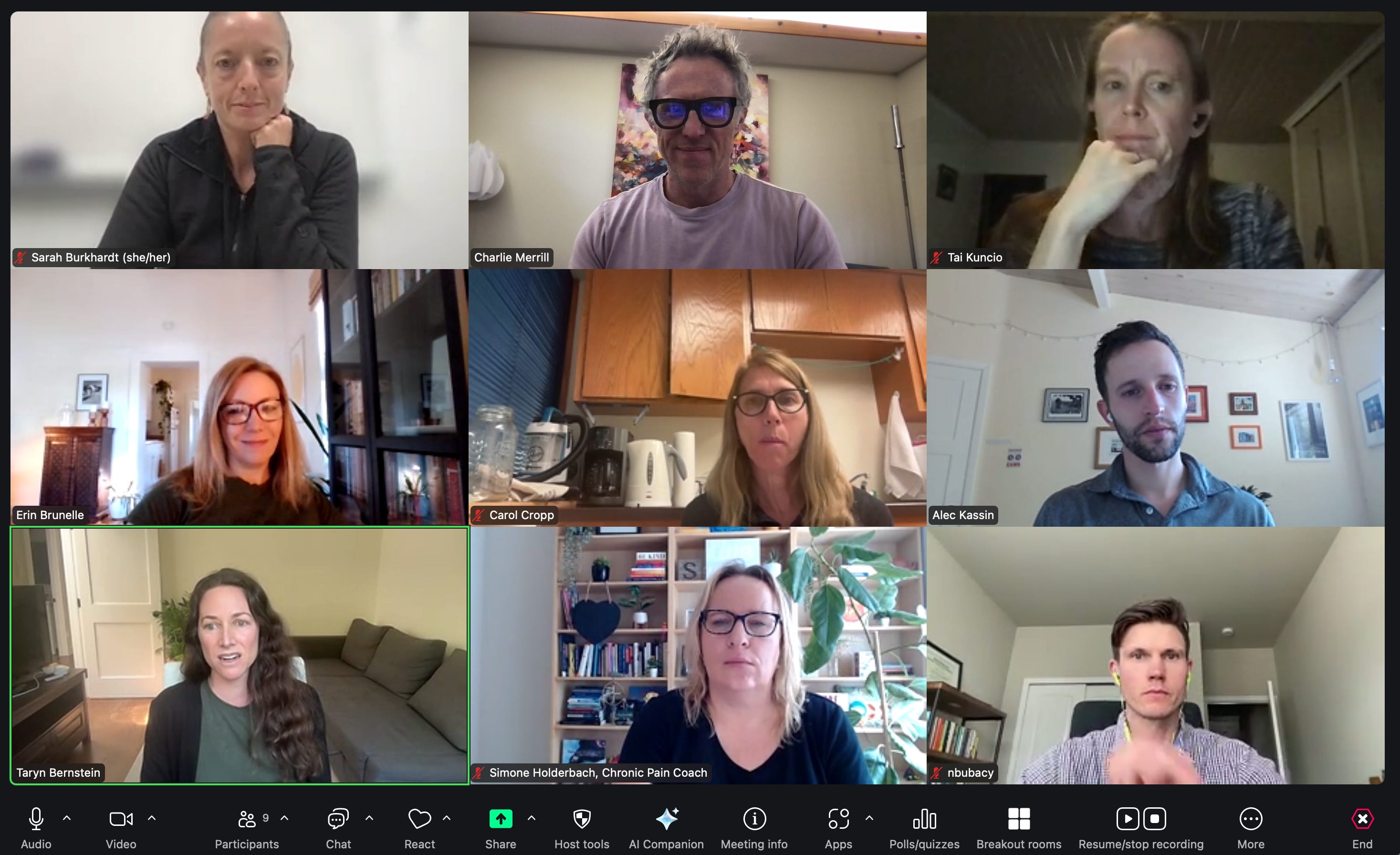
The course gives you the knowledge; the community makes sure you’re applying it in a way that’s actually tailored to you.
A Small Investment
Let’s be honest about the alternative for a second. The cost of staying where you are isn’t zero. It’s another season on the sidelines. Watching everyone else get after it in the highlight reels on Facebook and Instagram. Another year of guessing, googling, and getting nowhere with providers who are treating your body like a machine instead of a beautiful, resilient, and plastic miracle of nature. That alternative has a price too — you just don’t see a number attached to it. I know you’ve likely already spent a ton of money trying to fix your body, but this course offers value that stays with you for the rest of your life. Frustrating as it can feel, paradoxically, it’s the simplest and most affordable option that leads to your recovery.
Let’s focus on what’s in front of you instead of on the past:
The full 8-week Unlearning Pain For Athletes course — self-paced, fully asynchronous, yours forever. Revisit any week, any time, for as long as you’re doing this work.
A live community to do the work alongside people who get it — meeting every other Tuesday at 12 pm MT, with more time options coming soon.
Three decades of clinical insight, distilled into a framework you can actually apply, not just understand intellectually. Knowing is not doing. This course is about both.
The course is a one-time investment of $500 — less than the cost of a single visit with me, and you’ll have access to the framework for life. The community is $80/month, so you’re never locked into more time than you need. Stay a month to get unstuck, or stay a year to go deeper — you’re in control of your process.
There’s no artificial deadline here, because I’ve watched this work unfold differently for everyone. Some of you will feel like yourselves again before you even finish Week 8. Others will want to stay in the community much longer, and that’s exactly what it’s there for. This course meets you where you are, and supports you as long as you feel it’s helpful.
If you’re ready to stop waiting for permission to move again, start here → LINK.
Coming Back to the A Word
So — are you still intimidated by it?
I hope not. Not because I expect you to feel like an elite athlete tomorrow, but because I want you to stop disqualifying yourself from a word that was never about your mile time or your bench press to begin with. It was always about your relationship to your own body — your willingness to show up in it, move it, trust it, engage with the world in meaningful ways, and live inside it again to seek wonder & awe. The ingredients to a full life.
That part of you went quiet for a while. This course is how you turn the volume back up. See you on the inside.
Be well, my friends.