
There’s a big difference between the pain we choose and the pain that we don’t choose. We have agency over the former, while the latter often feels totally out of our control. Same pain, different quality of suffering.
Agency is the sense, the perception, that you have some control or influence over what’s happening. I spent a big chunk of the first half of my life as an endurance athlete. I chose suffering most days. It even became part of my identity. As a result, I got better at it, adapted to it, and benefited from it. I was practicing pain on purpose. You might say I had a high “pain tolerance” in the context of sport. After a while, the pain of sport was no longer pain. It actually became pleasurable.

But as time went on, I noticed something interesting. When pain appeared that I wasn’t expecting, pain I wasn’t choosing, my ability to navigate those experiences was completely different. A herniated disc in my back, broken ankle, broken wrist, severe frostbite on my toes, road rash and contusions from bike crashes, tendon pain, muscle strains, or meniscus tweaks. While I accepted that pain was part of sport, I didn’t sign up for that type of pain on that day. So it felt somewhat out of my control. Suddenly my pain “tolerance” didn’t matter. My subconscious brain, now perceiving danger rather than safety, turned the pain up as loud as it needed to get my attention. To protect me. As a result, this type of pain stuck around, often longer than it needed to, longer than I wanted it to, because of how I related to it. Independent of whether I was actually hurt or not.
Years ago, I overheard a guy at the rock-climbing gym talking about a major car crash he’d been recovering from. It happened 2 weeks earlier. He was the driver and was describing how he tried to avoid the crash but couldn’t. His partner was strapped in but asleep in the back seat and was startled awake by screaming, tires screeching, and the sound of crunching metal. Amazingly, the driver was already climbing again. He told his friend he really had no pain after the first week. But he shared that his partner was still really struggling and in a lot of pain. Of course I don’t know all the details of this crash, but it struck me that the driver had some control, while his partner had none. Basic pain neuroscience tells us that pain depends on context. While pain is sometimes connected to tissue damage, it tends to correlate more strongly with fear, emotion, uncertainty, and the meaning we attach to it…I wondered if this could explain, at least in part, the difference in their pain experiences. Not to mention mine.
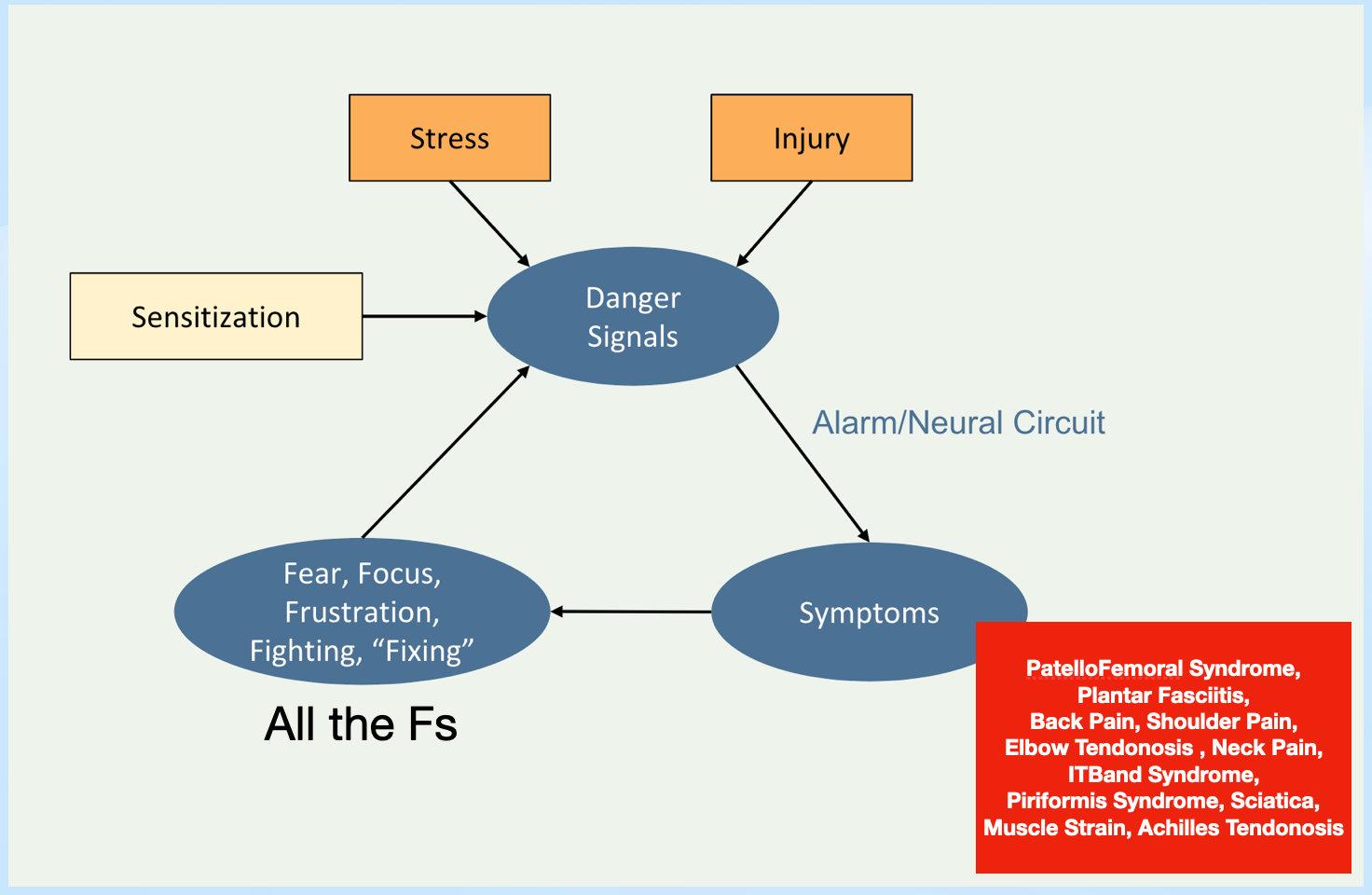
As a young athlete, every time I had unwanted pain, I felt instant fear and frustration; I focused on it, fed it attention, freaked out at times, fought it, and tried to fix it. All the normal but harmful Fs that are pitfalls to the recovery process. I blamed it on overtraining, on bike fit, on shoes, on biomechanics, on my body not being strong or flexible enough to handle training, on damage or injury. I felt like a victim. It felt out of my control. “Why is this happening to me? Not now! This is terrible! I’ll never feel better to be able to train again!” Sound familiar? All normal reactions early in the pain cycle. But completely unhelpful to healing and recovery. The suffering that this mindset created was a whole other beast. A mindset that I learned I needed to “train” differently.
Insta @hschubiner
But was this pain really that different? Or was it simply a perceptual difference connected to my sense of agency? Maybe I already had the skills. Maybe I just needed to change my perspective. My thoughts, feelings, and behaviors about the experience.
Turns out we can desensitize our mind and body to just about anything with some intentional practice and a new mindset. Fighters adapt to the impact of punching and kicking, soccer players to kicking the ball, cold plungers to freezing water, rock climbers to tight shoes and bloody fingers, breakdancers to wild body positions and repeated hard contact with the ground, ultrarunners to hours of impact forces, and big wave surfers to intense physical thrashings and hold downs. They desensitize themselves to this type of discomfort by choosing it. Over and over again. They lean into it. Play with it. Stay curious about it. They abolish the Fs. Over time, their mind and body stop caring so much. The pain and discomfort become normal, and the danger alarm becomes much less sensitive to the things it initially reacted to. They get better at it to the point where it’s no longer a barrier. The sensitivity basically resolves.
Insta @WSL
We worry that leaning into pain we’re not choosing will result in it sticking around. But the opposite is true. When we watch sensations, like pain, with vigilance, pressure, urgency, fear, hopelessness, and a catastrophic attitude, we feed it, strengthen it, and reinforce its presence. A fear-based reaction teaches our mind and body that pain is a threat, keeping us focused on it even more. Watching it like a hawk. We believe that if we keep an eye on it, it won’t hurt us. While this is true of some threats, it’s not true with pain.
But the goal isn’t to ignore pain either. When we become aware of pain, paradoxically, the goal is to welcome it, thank it, relate to it with humor, play with it, get curious about it, detach from the need for it to go away, and allow it fully as though it’s there for us. This is agency.
Here’s what modern pain neuroscience has established about agency (the sense that you have some control or influence over what’s happening) and how it alters our symptom experience:
Perceived control reduces pain intensity, even without actual control. Classic experiments show that simply believing you can control a painful stimulus (a button you could press, even if you never do) lowers reported pain compared to feeling the stimulus is entirely out of your hands.
Uncontrollable stress produces hyperalgesia; controllable stress often doesn’t. Animal and human studies both show that the same stressor leads to greater pain sensitization when the organism has no way to influence or escape it. Controllability, not just stress exposure, determines the physiological outcome.
Pain self-efficacy predicts disability better than pain intensity or tissue damage. In chronic pain populations, how much someone believes they can function despite pain is one of the strongest predictors of actual disability — often outperforming imaging findings or pain scores.
Helplessness and catastrophizing amplify pain through attention and threat appraisal, not just emotion. Catastrophizing (a mental state closely tied to low perceived control) is associated with increased activity in attention and salience networks, effectively turning up the gain on nociceptive signals reaching consciousness.
Fear-avoidance creates a self-reinforcing loop that agency can interrupt. Avoidance driven by perceived lack of control leads to disuse, deconditioning, and more pain — while graded engagement (restoring a sense of “I can do this”) tends to break the cycle.
Active coping is linked to less central sensitization than passive coping. People who engage in active strategies (pacing, exercise, problem-solving) tend to show less amplification of pain processing over time compared to those relying on passive strategies (rest, dependence on others, waiting for relief).
The descending pain modulatory system (PAG, RVM) is engaged more effectively under conditions of perceived control. Control-related cortical and prefrontal signals feed into the periaqueductal gray, strengthening top-down inhibition of spinal pain signals — this is part of why placebo and expectancy effects work.
Placebo analgesia depends heavily on agency and expectation, and engages real neurochemistry. It’s not “just belief” — controllable, agency-linked expectation triggers measurable endogenous opioid and dopaminergic release, changing actual nociceptive transmission.
Locus of control (internal vs. external) predicts long-term outcomes in chronic pain. People with a more internal locus of control tend to have better functional outcomes after injury or surgery, independent of injury severity.
Reappraisal-based therapies (like pain reprocessing therapy - PRT, or emotional awareness & expression therapy - EAET) reduce pain partly by restoring a sense of agency over symptoms and/or emotions/feelings. Brain imaging shows reduced activity in regions associated with threat and self-referential pain processing (e.g., anterior cingulate, insula) after treatments that specifically target beliefs about control and danger, even when nothing about the underlying tissue has changed.
A common thread here: your nervous system treats “controllable” and “uncontrollable” versions of the same input very differently. But agency isn’t just a coping style layered on top of pain — it’s an input the pain-processing system actually uses to decide how threatening a sensation feels. Luckily, the feeling of agency is driven by our PERCEPTION of control and automatic PREDICTION about how much control we actually have. You actually have agency over your feelings of agency! In terms of pain, while we may not be able to choose when and where we hurt, we always have a choice in how we respond. The relationship between perception and choice is actually one of the more interesting parts of this story.
Agency as perception: At a nervous system level, what predicts pain outcomes is the felt sense of control — what researchers call “perceived control” — not necessarily control that’s objectively verified. This is why giving someone an inert button that they believe controls the intensity of a shock lowers their pain, even though the button does nothing. The nervous system responds to a sense of control, not to a fact. In that sense, agency is a perceptual variable — something the brain constructs and feeds into its threat-appraisal system, similar to how it constructs a sense of body position, vision, or hearing. It can be manipulated, distorted, or mismatched with reality. If you’ve read any of my other stuff or follow me on Instagram, you know how I love a good illusion. If vision can be fooled, sensation can too.
Agency as choice (or at least as an act): Our perception of control is typically built from something. It’s built from actually testing our capacities, taking action, getting feedback, and updating our prediction of “can I influence this?” Graded exposure therapies (like return-to-movement programs) and pain reprocessing work partly because doing something safely and successfully changes the belief, not just because you were told to believe differently. So your perception of agency is often downstream of a choice or action, even though the perception itself is what does the physiological work of creating change.
A useful way to hold both:
Agency-the-perception is the proximate or direct variable — it’s what the nervous system (the descending modulatory system and threat-appraisal circuits for you nerdy neuroscience types) actually responds to in real time. It’s generally automatic, subconscious, and not immediately within our control. And it has a real impact on our body AS A RESULT of our perception.
Agency-the-choice (taking an action, making a decision, testing a limit) is often the mechanism by which that perception gets built, updated, and corrected. Just like pain can be learned through practice, it can also be unlearned. This where you have control. If you want to read an amazing new book written by my mentor and incredible human Howard Schubiner, check this out.

So you can’t always just decide to feel more agency and have it stick the way you can decide to get a drink of water. Belief that isn’t grounded in some real experience of efficacy tends to be fragile — it degrades under the first disconfirming experience, creating what we call “negativity bias”. Like when you get confident and try to run again, but flare up and walk home with your tail between your legs. Then you decide that running must no longer be possible for you anymore. Because pain and this type of learning are subconscious, “just think positive” doesn’t reliably reduce pain.
Saturday Night Live
While a shift in belief paired with a gradual return to activity often does. The latter actually generates the evidence - the awareness that your perception needs to be stable and lasting. So the leverage point of reclaiming your agency is usually action and feedback, not belief adjustment alone. Of course, the belief that pain is not due to damage and that pain can change is important. But the perception follows from real, even if small, tests of capability more reliably than it follows from willpower.
Here are 12 ways you can reclaim your agency as part of pain recovery:
