When I was 21, I developed back pain for the first time, actually really the only time. After an acute injury where I was skiing moguls all day at Arapahoe Basin in Colorado, it slowly worsened. It became intense and consistent, sending nerve pain down my right leg into my foot. I quickly lost the ability to run and cycle (I was a fairly strong amateur triathlete at the time), and I lost strength in my right butt and lower leg. The glute and lower leg muscles atrophied (shrunk). I was numb and tingly in my leg and foot, and I lost reflex in my Achilles. The pain was consistent, reproducible, and reliable in that it was worse with activity, worse in certain provocative positions, and better with rest. All signs of a structural spinal disc injury. An MRI revealed a massive herniated disc at L5/S1 (the lowest lumbar disc) on the right that was crushing my nerve root, which correlated exactly with my symptoms. I had all the red flag signs that would have indicated surgery, and this is naturally what the first doctor recommended.
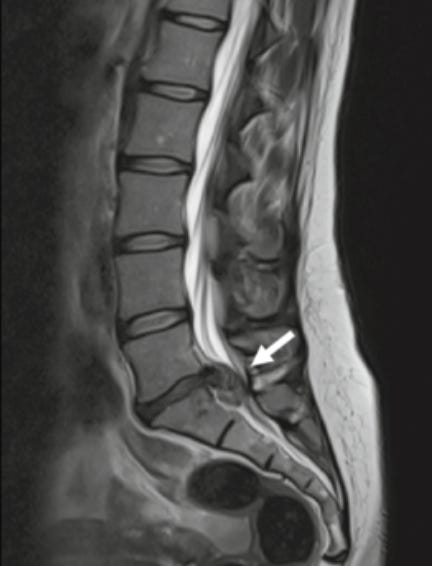
This, my friends, is called SPECIFIC (or structural) low back pain. It’s specific because there was an obvious cause, a smoking gun, clear tissue damage that explained why I hurt and included all the symptoms to match. According to the research, I was lucky enough (insert sarcastic tone here) to be one of the 1% of people who have an actual structural cause for their back pain. The other 99% of people who suffer from back symptoms that DO NOT have an obvious cause have what we call NON-SPECIFIC low back pain. While you might think this majority are the lucky ones, non-specific low back actually tends to cause more problems than its rarer structural variant. When we know there’s an “injury” informing the brain’s decision to create the experience of back pain, then there’s something clear we can treat. Non-specific low back pain, on the other hand, often hurts more, sticks around longer, comes and goes more frequently, results in more disability, and costs society way more to treat. Why is this? Because we’re treating the 99% like they’re the 1%.
The New York Times loves to talk about pain. Sometimes, they get it right; often, they don’t. Last month, they wrote a piece called “What Works for Low Back Pain? Not Much, a New Study Says“.

In it, they discussed the results of a systematic review of the 50 most common treatments for non-specific low back pain. The authors concluded that 90% of these interventions showed no evidence that they were effective. The other 10% showed little to no evidence that they had any ability to relieve pain. We’re talking about how, at best, people’s lower back pain decreased from a 7/10 to a 6.3/10. Not the kind of relief most people are hoping for. The study included surgery, injections, medication, manual therapies, core stability, stretching, yoga, pilates, massage, bracing, heat, ice, etc. The winner as the most effective treatment among these was….drum roll…. Advil! Y’all, what the fuck is wrong with us that we’re still leaning on treatments for back pain that are completely ineffective. While I hated this article because reading it felt like a waste time of everyone’s time stating the obvious and looking at the wrong problem…

…the author is unknowingly making an important point. None of these things work for non-specific low back pain because it’s not a body problem. It’s not an “issue with tissues.” The fact that we can’t find anything structurally wrong with the body, despite very real pain, should be our first clue. Yes, we find mechanical changes like muscle tension, transitory weakness here and there, altered movement, little asymmetries, fascial changes, and other things. While some clinicians make up stories about these things being important, they almost never add up to a pattern that explains why people hurt. The physical changes we see in 99% of back pain are a RESULT of the brain being in a state of danger alarm, not the cause of pain. They are incidental and normative findings that clear up as we address the underlying causes, like fear and other feelings. Said more simply, non-specific low back pain is solidly the result of the brain and nervous system in the absence of a structural problem.
My beef with this article was not that it was factually wrong. Most of the interventions that are commonly used to treat back pain ARE truly ineffective. I revolted more at the assertion that non-specific low back pain is somehow still a mystery. IT IS NOT. We have all the science and clinical strategies to support people in unlearning acute, chronic/persistent (ongoing), and recurrent (coming and going) back pain. But articles like this fail to share this truth, unintentionally leaving people more hopeless and fearful. And fear is what drives pain. I want you all to know (and please let everyone you know know) that:
All of the body-based/biomedical interventions this article mentioned work no better than placebo. In fact, when they work, it’s mostly due to placebo. And when they don’t work or make pain worse, it’s mostly due to nocebo. The nocebo effect describes the phenomenon where negative expectations or beliefs about treatments or interventions lead to undesirable outcomes or side effects, even if the treatment is inactive or harmless. Often simply because we’re concerned that the thing that is meant to help is not helping. But worse because the ill-informed things we hear from well-meaning providers themselves create more worry.
Most non-specific low back pain gets better when we DON’T treat it, don’t get MRIs, don’t do surgery or injections, don’t go to PT and chiropractic, don’t do core stability, and simply let it resolve on its own. Doing nothing and riding it out actually performs better than most traditional treatments.
Here are some other evidence-based “fun facts” about non-specific low back pain:
It’s the worst kind of back pain, commonly starting suddenly with severe 10/10 intensity.
It can be totally disabling, leaving even the toughest people unable to move and terrified. It turns out our brains don’t care about our pain tolerance and can turn symptoms up as high as they need to match our “toughness.” Remember, the pain we choose (intervals on the bike, for instance) differs from the pain we don’t choose (back pain that feels out of our control).
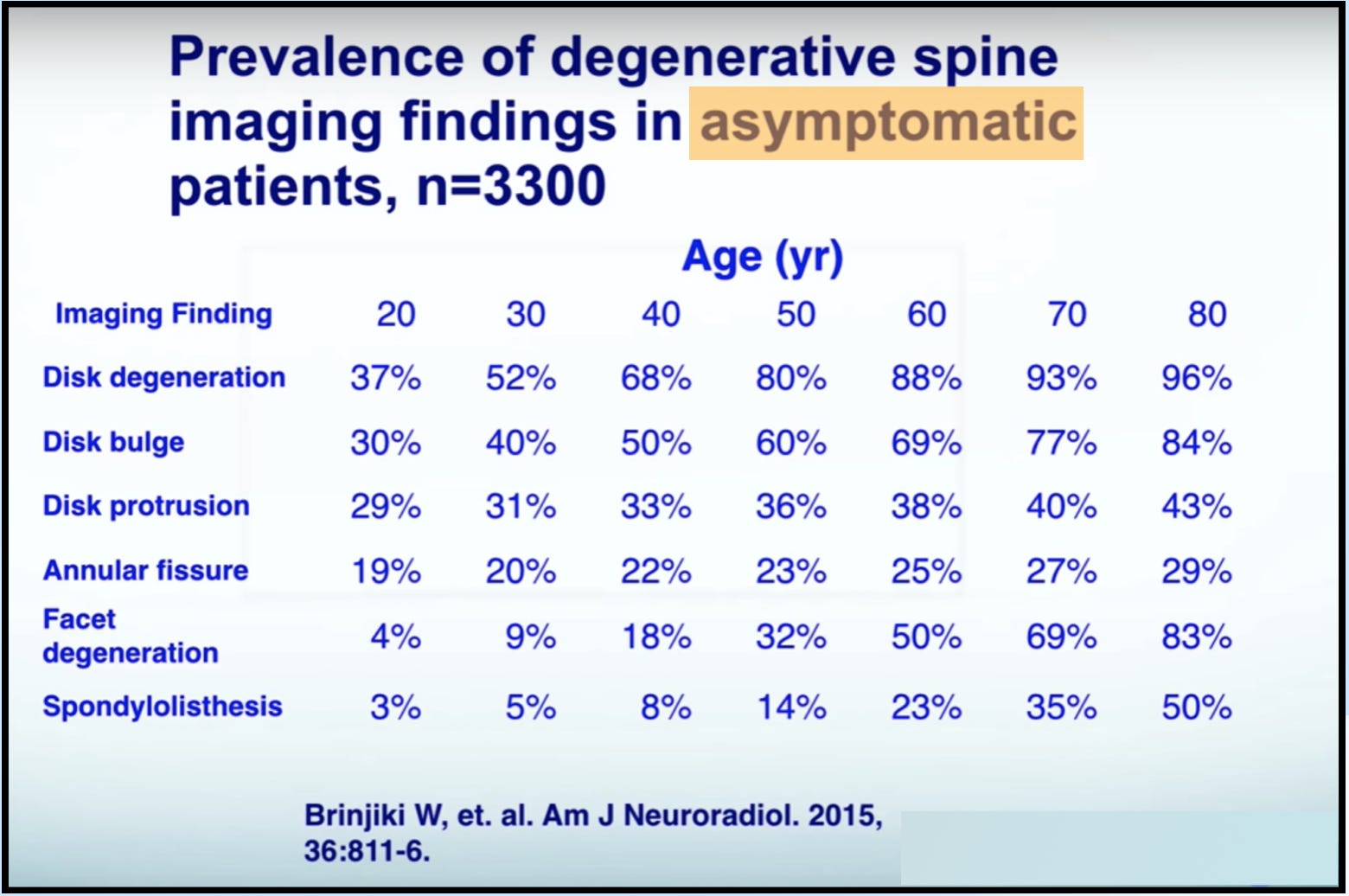
MRI scans reveal changes because we all have changes in our spine. But these are mostly normal and rarely correlate with non-specific low back symptoms. This study looking at 3300 pain free people is a favorite example of things like arthritis and degenerative change are normal after 20.
It’s often characterized by intense lower back pain, muscle spasms, glute pain, and sometimes leg symptoms that are vague, move around, or show up in parts of the leg that don’t match a structural cause.
It often starts out of nowhere but can be triggered by some benign physical activity or AFTER a physical activity that people fear might have hurt them.
It almost always starts around a time of discrete intense stress, during ongoing chronic life stress, by feelings of overwhelm, or by some other “psychological or social injury”.
It’s quickly amplified by fear of the pain itself, on top of fear of other things like politics, relationships, life changes, finances, etc.
Strong athletes and people with strong cores are not immune to non-specific low back pain. In fact, core stability and strengthening have no impact on non-specific back pain. There is no correlation. While it helps with performance and aesthetics (who doesn’t want ripped abs), it’s ineffective for back pain.
It can come and go at regular intervals or randomly, often with no clear physical trigger.
Benign movements and activities like picking up a light object, putting on shoes or pants, getting out of bed, cleaning the house, routine gym workouts, and other silly things can trigger a flare-up of the most intense back pain. These things don’t actually create injury but rather trigger the brain into a state of danger alarm for various reasons.